Remember The Chronicles of Narnia?

That’s how I felt when Jai Sovani-Garud first opened my eyes to Hindustani music theory. It felt like a small, simple doorway had been opened to reveal this massive, unique world that I had somehow never stumbled across over the course of years of arbitrarily wandering the internet for whatever extra musical knowledge I could get my hands on. Now this isn’t to say I had never heard or was not even familiar with the basics of Hindustani music and the theory behind it – I knew from years of listening to music and playing around on pianos that a flatted second scale degree had a sort of Indian Classical sound to it, but I never really knew why, and more importantly, I never knew how much more was out there.

That is until Jai came in with the thaatt table. If you Google “thaatt” by itself, sadly the results will be limited to a sort of phonetic spelling of the word “that” as it’s said by someone with a classic valley girl accent in a YouTube video. In reality, a thaatt is essentially the same as a mode in Western classical music or jazz. Thaatt’s, however, are organized by their use of “swars,” which tell you which notes in the scale are altered. Additionally, they use a system very similar to the Solfege system used in Western music, but with different syllables, i.e. “Sa” would be the same as “Do.”  In the thaatt table below, altered syllables are marked with either “_” for flat or “^” for sharp.
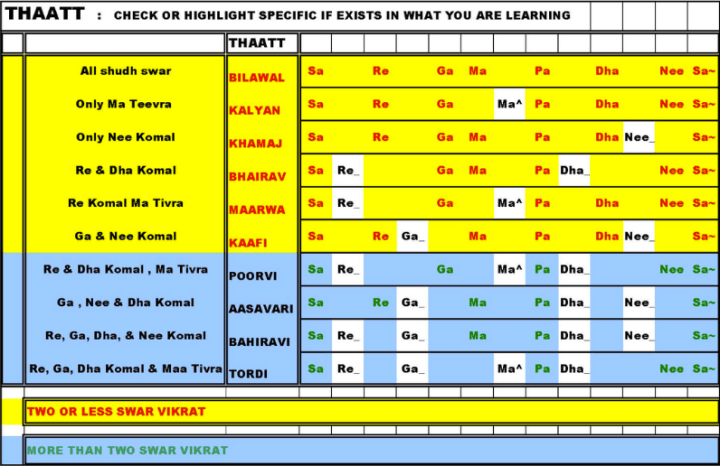
Screen Shot 2016-05-11 at 1.14.19 AM

Hindustani Narnia does not end here, though. In fact, this is where it all begins. Thaatt’s are never actually performed straight up and down (just as you wouldn’t typically see someone perform a scale straight up and down), so these end up being the basis of a raga or improvised lines within a raga. I’ve included an example below of a Raga Bhairav – if you skip to about the 1:25 mark, you can hear him improvising using the syllables and he continues to do this on and off for a while.

What’s more is that these thaatt’s are not even everything. That’s right – there’s virtually infinite ways to use these scales, and Jai proved that tenfold while working with us. However, one of what I think is the most interesting applications is how strategically these thaatt’s are used in context of a performance. If you actually play each one on a piano, you’ll notice that the first one is essentially a major scale and that each one becomes increasingly more minor or dark sounding due to the flatted scale degrees and increased appearance of the augmented second interval, which is what gives Hindustani and Carnatic music their unique sound. This is no accident. In fact, these scales are used strategically during different times of the day. In the table below you can see which ones are used during which hours, and yes, this is a standard, although what this table doesn’t show is that the scales during the early morning waking hours are the more “major” sounding scales, and the later you get into the day/night, the darker and more minor the scales become.

Screen Shot 2016-05-11 at 1.26.41 AM

You’ll also notice that there are scales on here not written in the thaatt table. That’s because, like I said, this is Hindustani Narnia, where the possibilities never end, which Jai proved to us as she began to teach us both a raga and some ways to improvise on it, more of which will follow in the next post!
Imagine you have two glass jars full of jelly.

Everything about them is as identical as you can possibly make it – how high you hold them, the angle you hold them, their size and weight, the amount of jelly in them, down to the last possible detail. Then you drop them. They fall to the ground, hitting the ground at nearly the exact same time. The second they hit the ground, though, they are no longer identical – they shatter in a million directions, neither of them breaking at all in the same way.

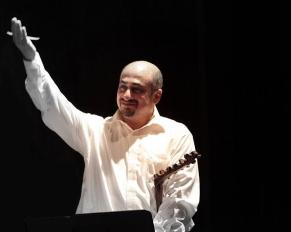
In his final venture with our class, Issa used this analogy to describe maqams and their individual development. The initial, nearly identical impact of the jars is diwan (the scale used starting on “D” – this is explained in Part 1 if you missed it), and everything after that is simply color. So while two maqams might both be in diwan, each melody provides unique color. In continuing the analogy, Issa went on to say that the next step would be the composer coming through and stepping in the jelly, representing the evolution of maqam over time.

We also spent some time talking about intonation and tuning again, this time without having to spend as much time working on getting Western scalar patterns out of our head (though I’d be lying if I said we didn’t have to review that a bit…old habits die hard).

This time, Issa focused more on the Equal Temperament System – or the lack thereof in the non-Western world. For those unfamiliar, the Equal Temperament System is essentially the standardized tuning system used in many areas of the world but namely for instruments in Western music so that, when tuned properly, different instruments can more easily produce identical pitches. While this is used widely, there are also many areas of the world it is not used. For example, gamelan, African log/tongue drums, and gyil are examples of non-Western instruments built simply to be in tune with themselves. In some cases, this is just how these instruments are traditionally made due to the lack of resources when they were initially created, but in the case of things like gamelan, the difference in tuning even between instruments within the same ensemble actually creates just enough harmonic tension to help these instruments carry outdoors. Examples of each can be heard below:

A more recent example of intentionally not following the Equal Temperament System is with hand pans. Though these are considered part of the steel pan family and steel pans are typically tuned using the Equal Temperament System, hand pans were initially built, tuned, and used specifically for the purpose of physical and spiritual healing, so they were intentionally tuned to themselves without using the Equal Temperament System so they could not be played with other instruments. If you haven’t heard hand pans before, I’ve included a clip below:


These last four weeks with Issa Bolous have been invaluable – I have learned more about Middle Eastern music than I likely could have ever figured out for myself, and what I have been able to reiterate through this blog is only the tip of the iceberg. I know I will be doing more research of my own with time, but now it is time to look forward to the next step in this analytical discourse – Hindustani music!

Last week, I wrote a brief overview of the very dense world of maqam theory. This week, Issa gave us a look into more of the cultural/traditional side of Middle Eastern music which, as I’m sure you could guess, is just as dense, if not more so, since its history has run so deep for so long.

Like most traditional music, Middle Eastern music like maqams got their start in religion, mostly as Quranic meditation. The difference between this and something like Medieval church music is how it progressed – over time, even though Medieval church music was not originally intended or even thought of as music, it did eventually become exactly that, even within the realms of the church, as Gregorian Chant started to include harmony and more complex rhythm for the sake of the music itself. In Middle Eastern countries, “religious police,” as Issa referred to them, were not only against so much as referring to meditations as music but actively acted out against the mentality. Now, of course, the term “religious police” is used lightly – these were conservative traditionalists that were more or less against adapting for non-religiously driven reasons.

This, of course, didn’t actually stop the music from evolving – what I see as the natural human instinct to progress and improve resulted in the music (even though it was not considered that at the time) being slave to the religious text it had supported since the beginning. As a result, melodic lines in music never took precedence over the text.

Obviously, this didn’t stay the case forever. There is now plenty of music for music’s sake in the Arab world. In fact, one art form Issa showed us that I personally had never seen before (at least in Arab culture) were a few clips of what are essentially Arab musicals. For example, he introduced us to a female vocalist named Fairouz, a star in this world. Check out some of it for yourself at this link below (embedding was disabled for this video):

https://youtu.be/y0DwuRs7fuI


He also some time talking about the rhythmic concept of what he referred to as “borrowing time.” To demonstrate, he had me hold steady rhythm while he played his oud – as I did my best to hold steady, I did notice that we didn’t feel together every once in a while, but as we kept playing, I realized it was usually at the ends of phrases and that he would always end up right back with me. In Western terms, this was essentially “quasi time” or a brief moment of rubato. This is also a technique used often in jazz, especially during solos, but also occasionally used with melodies, which is more similar to this style since, like the melody of a jazz tune, the melody of an Arabic song would still be driven by diction of the original text, leading to a common downbeat. Here is an example – this is a longer one which I’d recommend listening to the entirety of if you have time, but if not, skip to about the 4:24 mark where the vocal line comes in and you can hear this very obviously:


One of the most thought-provoking things for me, though, was the time he took to clarify the difference between Arab and Arab speaking. Of course, I knew that not everyone that lives/has lived in or whose ancestors are from the Middle East is Arab, I admittedly hadn’t ever given that much thought to the space between the language and the religion. His biggest point was that, though someone may speak Arab, this does not necessarily mean they are Arab. Especially in what, for whatever ridiculous reasons, has seemingly become a more hostile racial environment here in the US, I think this is an extremely important thing to remember.

He went on to talk about the extreme differences in dialects among Arab speakers regardless of religion, saying that the differences between the two most extreme dialects are significantly more different than the same in English, so much so that many in that situation prefer to speak to each other in English because it is simply easier. The best example of this I can think of would be someone raised with a thick Southern accent trying to talk to someone from a Caribbean island – while both speak English natively, the dialects are so incredibly different than it may be easier for them to speak to each other in another common language if possible.

The line I mentioned just before between Arabs and Arab speaking people still causes social and political riffs to this day, many of which end up making headlines one way or another even here in the US. Just like the US though, this is good cause to create art, and music has definitely been an outlet there just as it is for us. This last video is a great example – in fact, it touches on a handful of issues covered from this past week, and is should therefore be a great note to end on!

“Leave your ego at the door.” This is phrase we often hear when starting something new, especially something with the particular expectation of “earning your way” just like everyone else before you.

issaWhat about this one – “leave your knowledge at the door.”

How often is this expected, and from a college professor, no less? This was the first bit of advice out of guest lecturer and master Oud player Issa Bolous’ mouth at the beginning of his first of four weeks of guest lectures with our class. If you haven’t studied anything like Middle Eastern music before, this may seem crazy, but after two weeks of guest lectures with Issa, I’d recommend doing exactly that before even continuing to read this post.

Now with that said, if you have absolutely no musical background, you may get a little lost, but in all honesty you may be in a better starting place than those of us with music degrees. Why? Middle Eastern music goes against many of the skills musicians take years, sometimes even lifetimes, trying to master. As a result, melodies in Middle Eastern music are often very difficult to sing for those trained in the Western classical traditions.

Where the difficulty is shared with those without training is listening. To most Western ears, this music, which can be heard below, sounds “unrefined” or even out of tune.

This sound is not what it seems – in fact, this music is quite refined and almost impeccably in tune, but based on a quarter tone scale, which includes notes between each note we are accustomed to on, say, a standard 88-key piano.

This particular audio example is a maqam bayati – a particular Middle Eastern form that is characterized by its form as well as its Phrygian mode (minor key with a lowered 2nd scale degree, i.e. playing E to E on a piano playing only white keys).

As I mentioned before, this scale in this context includes quarter tones. More specifically, this particular maqam is in diwan, which means it begins and ends on D. A typical D Phrygian scale would look as follows:

D – Eb – F – G – A – Bb – C – D
*listen here

Bayati, however, would look as follows, including the half flats (denoted by “hb”):

D – Ehb – F – G – A – Bhb – C – D
*listen here

Similarly, there is another maqam known as “hijaz” that is similar to what we know as the Phrygian Dominant scale. In Western music, the Phrygian Dominant scale is mostly used in jazz and includes a major 3rd scale degree. In this case, the Phrygian Dominant scale is the same as hijaz and spells out as follows:

D – Eb – F# – G – A – Bb – C – D
*listen here
//commons.wikimedia.org/wiki/File:Arabic-scale_hijaz.ogg?embedplayer=yes

Though we don’t see the half flats in hijaz, they do tend to be difficult for our Western earns to hear as anything but out of tune. While I have started to become accustomed to listening to this, being able to sing it is still, by far, one of the most difficult adjustments I have had to make.

There is significantly more to learn with Issa over his next two weeks with us, but there is a lifetime worth of understanding before I could ever claim any amount of mastery.


To check out more examples of Middle Eastern scales, there is a great list of midi audio samples on this Wikipedia page.

To learn more about Issa Bolous, make sure to visit his website here.

Michael McSweeney is a Masters student at Northern Illinois University. This blog serves as a record of analytical reflection for Analytical Techniques of World Music, a graduate course lead by Dr. Jui-Ching Wang, Director of World Music studies at Northern Illnois University.

For more information about Michael McSweeney, visit the rest of this website starting here.